
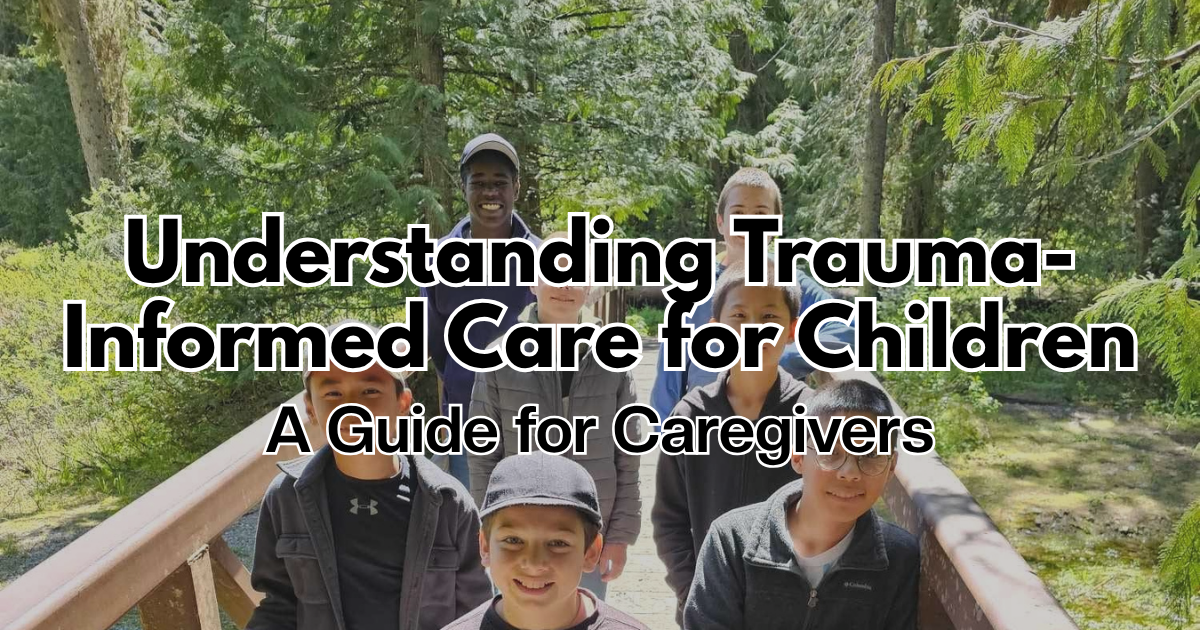
Children who have experienced trauma may respond to the world in ways that can be difficult for adults to understand. Behaviors such as anger, withdrawal, anxiety, defiance, difficulty trusting others, or trouble regulating emotions may be connected to experiences that have affected a child's sense of safety and security.
Trauma-informed careTrauma-informed care — An approach that recognizes how trauma affects behavior, emotions, and relationships, and responds by prioritizing safety, trust, collaboration, and supportive accountability. begins with a different question. Instead of asking, "What's wrong with this child?" caregivers ask, "What may have happened to this child, and what does he need to feel safe and supported?"
This approach can help caregivers, families, schools, and children's organizations create environments where children feel understood, respected, and supported. For children who have experienced trauma, consistent relationships, predictable routines, and compassionate guidance can become important parts of the healing process.
What Does It Mean to Provide Trauma-Informed Care?
Trauma-informed careTrauma-informed care — An approach that recognizes how trauma affects behavior, emotions, and relationships, and responds by prioritizing safety, trust, collaboration, and supportive accountability. is an approach to supporting people that recognizes how trauma can affect their emotional, behavioral, physical, and social well-being.
According to the National Child Traumatic Stress Network (NCTSN), trauma-informed caretrauma-informed care — An approach that recognizes how trauma affects behavior, emotions, and relationships, and responds by prioritizing safety, trust, collaboration, and supportive accountability. involves recognizing the impact of traumatic stress and using that understanding to create safer and more supportive environments for children, families, and caregivers. The NCTSN emphasizes collaboration, safety, resilienceresilience — The capacity to recover from adversity and continue developing through supportive relationships, skills, and protective factors., and strong relationships as important parts of trauma-informed systems.
Trauma-informed careTrauma-informed care — An approach that recognizes how trauma affects behavior, emotions, and relationships, and responds by prioritizing safety, trust, collaboration, and supportive accountability. does not mean excusing harmful behavior or eliminating boundaries. Instead, it means understanding that a child's behavior may communicate an unmet need, fear, or response to past experiences.
For caregivers, this perspective can change how they respond to difficult moments.
Rather than responding only to the behavior, they can consider what might be happening underneath it.
The Impact of Childhood Trauma on Emotional and Behavioral Health
Childhood trauma can result from experiences that overwhelm a child's ability to cope or create a serious threat to their sense of safety. Trauma may involve abuse, neglect, violence, loss, family instability, serious accidents, or other frightening or overwhelming experiences.
Not every child responds to the same experience in the same way. Children can also experience different forms of trauma, including acute trauma, chronic trauma, and complex trauma.
The effects of childhood trauma can sometimes appear through changes in behavior, emotions, relationships, learning, or a child's ability to regulate stress.
The National Child Traumatic Stress Network's resources on child trauma provide additional information about how traumatic experiences can affect children.
Understanding these effects is important because trauma responses can sometimes be mistaken for simple disobedience or a lack of motivation.
A child who becomes overwhelmed by a seemingly minor situation may not be intentionally trying to cause problems. His response may be connected to a nervous system that has learned to stay alert for danger.
That does not mean every challenging behavior is caused by trauma. It means caregivers should consider the whole child and the circumstances surrounding the behavior.
6 Essential Core Principles of Trauma-Informed Care
While trauma-informed approaches can look different depending on the setting, several principles are especially important when caring for children.
1. Prioritizing Safety
Children who have experienced trauma often benefit from environments where they know what to expect and where adults respond consistently.
Physical safety matters, but emotional and psychological safetypsychological safety — A felt sense that one can express needs, ask questions, and make mistakes without fear of humiliation, rejection, or harm. matter as well.
A child may feel safer when caregivers:
- Establish predictable routines
- Explain expectations clearly
- Follow through consistently
- Avoid unnecessary threats or intimidation
- Provide calm responses during difficult moments
- Give children appropriate choices
- Create opportunities for children to ask questions
A predictable environment can help reduce uncertainty and give children a stronger foundation from which to learn and build relationships.
2. The Importance of Healthy Relationships
Healing does not happen in isolation.
Strong, trustworthy relationships can be particularly important for children who have experienced disrupted relationships, neglect, abuse, abandonment, or other forms of trauma.
A trauma-informed caretrauma-informed care — An approach that recognizes how trauma affects behavior, emotions, and relationships, and responds by prioritizing safety, trust, collaboration, and supportive accountability.giver works to become a consistent and dependable adult in a child's life.
That may mean showing up when promised, listening without immediately judging, recognizing progress, and continuing to provide support even when a child struggles.
For children who have difficulty trusting adults, trust may take time.
It cannot always be demanded. It often has to be built through repeated experiences of safety, consistency, patience, and respect.
At Raising Arrows Children's Home, creating a stable and nurturing environment is an important part of the home's mission. Learn more about who Raising Arrows serves and its Christ-centered, trauma-informed approach.
3. Viewing Behavior as Communication
One of the most important ideas in trauma-informed caretrauma-informed care — An approach that recognizes how trauma affects behavior, emotions, and relationships, and responds by prioritizing safety, trust, collaboration, and supportive accountability.giving is learning to look beyond behavior.
A child's behavior may communicate fear, frustration, confusion, insecurity, overstimulation, or a need for connection.
For example, a child who shuts down when corrected may not simply be refusing to cooperate. A child who becomes extremely angry over a small disappointment may be struggling with emotional regulationemotional regulation — The ability to identify, process, and manage emotions in a healthy way, especially during stress, disappointment, or conflict..
This does not mean caregivers should ignore boundaries.
Instead, trauma-informed caretrauma-informed care — An approach that recognizes how trauma affects behavior, emotions, and relationships, and responds by prioritizing safety, trust, collaboration, and supportive accountability.giving combines compassion with appropriate expectations.
Adults can communicate:
"You are still responsible for your actions, and I am here to help you work through this."
That combination of accountability and connection can be more constructive than responding with shame or rejection.
4. Building Trust Through Consistency
Consistency is especially important when working with children who have experienced instability.
When rules, routines, and adult responses change constantly, children may have difficulty knowing what to expect.
A consistent environment can provide reassurance.
This might include:
- Regular meal and bedtime routines
- Clearly communicated expectations
- Consistent consequences
- Predictable transitions
- Reliable adult support
- Regular opportunities for positive interaction
Consistency does not mean that every day has to go perfectly. Life is unpredictable. Instead, it means children can learn that the adults around them are dependable even when circumstances change.
5. Empowering Children with Choices
Trauma can leave children feeling powerless.
Whenever appropriate, caregivers can give children opportunities to make choices and participate in decisions that affect them.
Simple choices can make a difference:
"Would you like to do your homework before or after your snack?"
"Would you like to talk about what happened now or after you've had some time to calm down?"
Offering choices does not mean giving children complete control. It means giving them an appropriate sense of agency within safe boundaries.
Over time, these experiences can help children develop confidence, responsibility, and self-awareness.
6. The Power of Collaboration
Trauma-informed careTrauma-informed care — An approach that recognizes how trauma affects behavior, emotions, and relationships, and responds by prioritizing safety, trust, collaboration, and supportive accountability. works best when the adults supporting a child communicate and work together.
Parents, caregivers, teachers, counselors, and other professionals may each see different parts of a child's experience. Sharing information appropriately can help create greater consistency across the child's environment.
The NCTSN describes trauma-informed systems as those that emphasize collaboration among children, families, caregivers, and professionals while working to maximize physical and psychological safetypsychological safety — A felt sense that one can express needs, ask questions, and make mistakes without fear of humiliation, rejection, or harm. and support recovery.
Practical Strategies for Trauma-Informed Parenting
Trauma-informed parenting is not a special set of techniques that guarantees a child's behavior will immediately change.
Instead, it is a way of approaching parenting and caregiving with greater awareness of how trauma can influence a child's reactions.
A trauma-informed parent or caregiver may:
- Focus on connection before correction when appropriate
- Maintain predictable routines
- Give clear and reasonable expectations
- Avoid unnecessary power struggles
- Help children identify and regulate emotions
- Celebrate progress instead of focusing only on mistakes
- Allow trust to develop gradually
- Respond calmly during difficult situations
- Look for patterns or potential triggers
- Seek professional support when appropriate
The goal is not to remove every challenge from a child's life.
The goal is to help children develop the skills and confidence they need to navigate challenges in healthier ways.
How Trauma-Informed Approaches Support Healing and Resilience
There is no single path to healing from trauma, and trauma-informed caretrauma-informed care — An approach that recognizes how trauma affects behavior, emotions, and relationships, and responds by prioritizing safety, trust, collaboration, and supportive accountability. is not a substitute for professional mental health treatment when treatment is needed.
However, the environment surrounding a child can make an important difference.
Children who experience consistent, supportive relationships may have more opportunities to develop trust, emotional regulationemotional regulation — The ability to identify, process, and manage emotions in a healthy way, especially during stress, disappointment, or conflict., communication skills, and resilienceresilience — The capacity to recover from adversity and continue developing through supportive relationships, skills, and protective factors..
The NCTSN emphasizes strengthening resilienceresilience — The capacity to recover from adversity and continue developing through supportive relationships, skills, and protective factors. and protective factors for children and families affected by trauma. Trauma-informed systems also recognize the importance of continuity of care and collaboration among the people supporting a child.
In practical terms, healing may look gradual.
A child may begin asking for help instead of shutting down. He may learn to identify what he is feeling. He may become more comfortable accepting encouragement. He may begin to trust that an adult will respond consistently.
These small changes can represent meaningful progress.
Trauma-Informed Care vs. Permissive Parenting: Key Distinctions
A common misconception is that trauma-informed caretrauma-informed care — An approach that recognizes how trauma affects behavior, emotions, and relationships, and responds by prioritizing safety, trust, collaboration, and supportive accountability. means allowing children to do whatever they want.
It does not.
Children still need boundaries, expectations, accountability, and consequences that are appropriate to their circumstances and development.
The difference is in how those boundaries are communicated and enforced.
A trauma-informed approach seeks to avoid unnecessary shame, humiliation, intimidation, or fear while still teaching responsibility.
The message becomes:
"Your behavior matters, and you are still worthy of care and connection."
That distinction can be especially important for children who already carry feelings of rejection, shame, or worthlessness.
How to Build a Trauma-Informed Environment
Creating a trauma-informed environment requires more than training one caregiver or adopting a few new techniques. It involves creating a culture where children's experiences and needs are considered in everyday decisions.
For organizations serving children, this may include:
- Training staff to understand childhood trauma
- Developing predictable routines and procedures
- Creating clear behavioral expectations
- Encouraging strong family partnerships
- Providing appropriate mental health resources
- Supporting staff wellness
- Maintaining safe physical and emotional environments
- Communicating consistently with children and families
The NCTSN notes that trauma-informed organizations incorporate trauma awareness, knowledge, and skills into their organizational cultures, practices, and policies.
This is particularly important in settings where children spend significant amounts of time, including schools, children's homes, residential programs, and other child-serving organizations.
Our Commitment: Trauma-Informed Care at Raising Arrows
At Raising Arrows Children's Home, the mission is centered on providing a stable, Christ-centered environment for boys who may be dealing with trauma, attachment challenges, academic struggles, and difficult family transitions.
The home emphasizes structure, faith, mentorship, academics, and relationships as part of creating an environment where boys can grow.
For families considering whether a structured children's home may be appropriate for their son, learning about the environment and approach is an important part of the decision-making process.
You can learn more about Raising Arrows Children's Home or explore the School for Adopted Boys to learn more about the support and structure provided to students.
Supporting Long-Term Healing and Resilience
One of the most important things caregivers can remember is that healing from trauma rarely happens overnight.
A child may make progress and then struggle again. A behavior that seemed to disappear may return during a stressful period. Trust may take months or longer to develop.
These setbacks do not necessarily mean that a child is failing.
Healing is often a process of building new experiences.
Every consistent interaction can reinforce an important message:
You are safe. You are valued. You are not alone.
For caregivers, that means continuing to provide patience, structure, compassion, and appropriate accountability even when progress feels slow.
Key Takeaways: Supporting Children with Trauma-Informed Care
So, what is trauma-informed caretrauma-informed care — An approach that recognizes how trauma affects behavior, emotions, and relationships, and responds by prioritizing safety, trust, collaboration, and supportive accountability.?
At its heart, trauma-informed caretrauma-informed care — An approach that recognizes how trauma affects behavior, emotions, and relationships, and responds by prioritizing safety, trust, collaboration, and supportive accountability. means recognizing that a child's past experiences can influence how he responds to the people and world around him and allowing that understanding to shape how adults provide support.
For children who have experienced trauma, healing can begin with something as fundamental as feeling safe with a dependable adult.
Consistent routines, compassionate communication, healthy boundaries, meaningful relationships, and collaboration among caregivers can all contribute to a supportive environment where children have opportunities to build resilienceresilience — The capacity to recover from adversity and continue developing through supportive relationships, skills, and protective factors. and move toward a healthier future.
At Raising Arrows Children's Home, we believe that children are more than their past experiences or current struggles. With faith, structure, encouragement, and consistent support, they can continue growing toward the purpose and future God has for them.
Additional Resources for Trauma-Informed Care
Families who want to learn more about Raising Arrows Children's Home can explore our programs and mission, learn who we serve, or visit our FAQ page for answers to common questions about admissions, academics, and life at Raising Arrows.
For additional information about childhood trauma and trauma-informed caretrauma-informed care — An approach that recognizes how trauma affects behavior, emotions, and relationships, and responds by prioritizing safety, trust, collaboration, and supportive accountability., visit the National Child Traumatic Stress Network and SAMHSA's trauma-informed caretrauma-informed care — An approach that recognizes how trauma affects behavior, emotions, and relationships, and responds by prioritizing safety, trust, collaboration, and supportive accountability. resources.