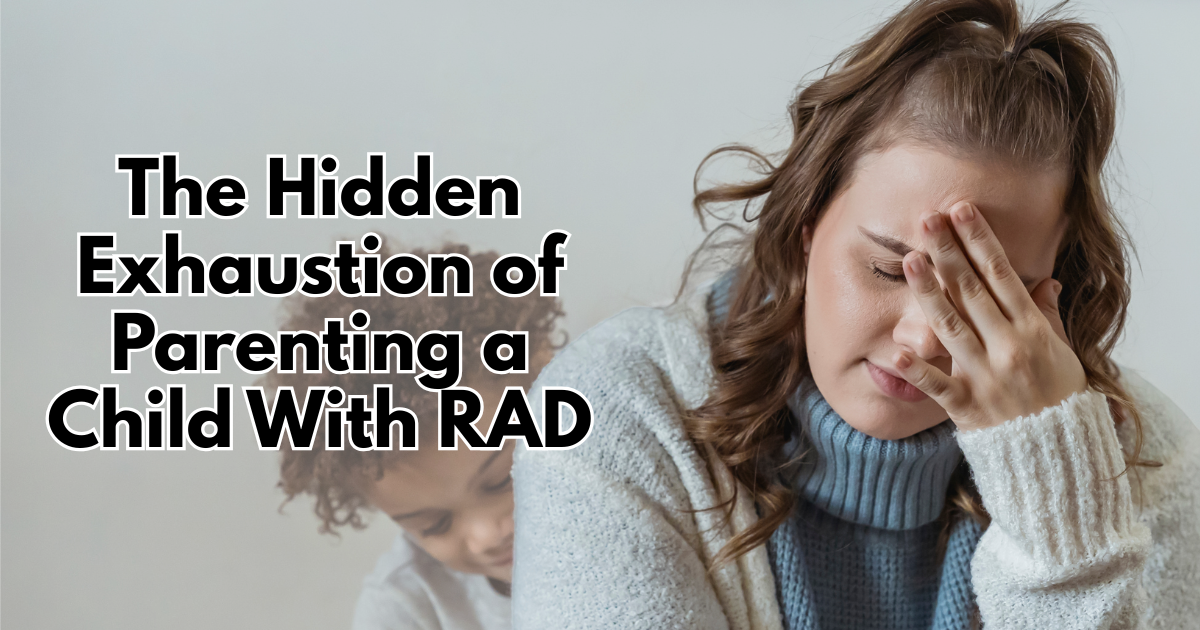
Parenting a child with Reactive Attachment Disorder (RAD) is often described as one of the most challenging and isolating experiences a caregiver can face. It is a journey where love alone is not enough, and where the exhaustion runs far deeper than a lack of sleep, it permeates the mind, body, and soul. This hidden exhaustion is the reality for countless families, and it is a burden that is seldom understood by those who have not lived it. For many parents, the daily reality of parenting a child with RAD feels like walking through a minefield blindfolded, never knowing when the next explosion will come.
For the primary caregiver, often the mother, this exhaustion is rooted in a painful paradox: you are the nurturing enemy. A child with RAD, whose early trauma has taught them that attachment is a threat to their survival, often targets the very person trying to provide love and stability. You become the receptacle for their anger, manipulation, and fear. This constant state of being on guard, of being the target, leads to a profound, soul-deep weariness that no amount of rest can fix. The child's behaviors are not personal, yet they feel deeply personal. Every rejection, every accusation, every act of defiance chips away at the parent's heart until they feel hollowed out and spent.
The Physical and Emotional Toll
The chronic stress of parenting a child with RAD is not just emotionally draining; it takes a significant physical toll. Caregivers often find themselves in a state of hypervigilancehypervigilance — A state of constant heightened alertness and anticipation of danger—experienced by both children with RAD and their exhausted caregivers who must always be ready for the next crisis., always anticipating the next crisis, worried about the safety of other children, pets, or even the child themselves. This constant alertness leaves little room for normal life. Fun, vacations, and social outings can feel like impossible luxuries when you are just trying to survive the day. A simple trip to the grocery store can become a logistical nightmare, fraught with potential triggers and public meltdowns that leave parents feeling judged and humiliated.
This persistent stress manifests in tangible health problems. Many parents report worsened headaches, insomnia, anxiety, and depression. Over time, the strain can contribute to high blood pressure and other stress-related illnesses. The emotional exhaustion is equally profound, often leading to a state known as "blocked careblocked care — A neurological self-protective response in which a caregiver's nervous system shuts down empathy after repeated rejection—not a failure of love, but a sign that the caregiver urgently needs support.," where a parent's nervous system, in an act of self-preservation, shuts down empathy to protect against repeated rejection and heartbreak. This is not a sign of failure but a neurological response to an impossibly difficult situation. When a parent has poured out every ounce of love and received only rejection in return, the heart eventually builds walls just to survive.
The grief that accompanies parenting a child with RAD is another layer of this hidden exhaustion. Parents grieve the child they dreamed of having, the family they imagined, and the simple joys of parenting that others seem to experience effortlessly. They grieve the loss of normalcy, the loss of trust within their own home, and often the loss of relationships with extended family members who cannot understand or accept the reality of the situation. This grief is complicated and ongoing, a constant companion on a journey that feels endless.
The Isolation and Misunderstanding
Compounding the exhaustion is the profound isolation families experience. The public face of a child with RAD is often charming and delightful, a stark contrast to the chaotic and often destructive behaviors exhibited behind closed doors. This discrepancy leads to a heartbreaking reality: few people believe the extent of the struggle. Friends, family, and even professionals may see a "normal" child and inadvertently dismiss the parent's cries for help, leaving them feeling unseen, unheard, and utterly alone.
This isolation extends to marriages and relationships. The disorder is adept at creating division and triangulationtriangulation — A relational manipulation in which a child with RAD pits one caregiver against another, creating division and undermining unified parenting—a common source of marital strain in RAD families. within a family, often pitting one parent against the other and eroding trust. Siblings often suffer in silence, feeling neglected or becoming victims of the child's manipulation and aggression. The financial strain of therapy, property destruction, and legal issues adds another layer of pressure, making the exhaustion feel inescapable. One parent aptly described the sense of being misunderstood by stating, "It's easy to have an opinion about raising a kid with reactive attachment disorder, but it's the hardest thing in the world to actually do."
The shame that accompanies parenting a child with RAD is another heavy burden. Many parents feel like failures, believing that if they had just been better, loved harder, or tried more, their child would have healed. They may avoid social situations, withdraw from church communities, and isolate themselves from friends who cannot understand why they cannot "control" their child. This shame is toxic and unwarranted, yet it persists because the world so often judges what it does not understand. Parenting a child with RAD requires a level of strength, patience, and resilience that most people cannot fathom.
The Financial and Practical Realities
Beyond the emotional and relational toll, parenting a child with RAD carries significant practical and financial weight. Therapeutic interventions, whether it is specialized therapy, residential treatment, or an out-of-home placementout-of-home placement — A decision to place a child in a residential or boarding home setting when the family system requires relief and the child requires more intensive, structured care than the home can provide alone. like Raising Arrows Children's Home, are expensive and often not fully covered by insurance. Many families deplete their savings, take on second jobs, or make significant financial sacrifices to get their child the help they need.
Property destruction is another grim reality for many families. Walls may have holes, doors may be broken, furniture may be destroyed, and cherished items may be ruined. The constant cycle of repair and replacement is exhausting and demoralizing. Parents often find themselves living in a home that feels more like a war zone than a sanctuary, a constant reminder of the chaos that has invaded their lives.
Legal issues also frequently arise. Children with RAD may engage in behaviors that attract the attention of law enforcement, and parents may find themselves navigating the justice system, advocating for their child in courts, and managing the stress of legal proceedings. This adds yet another layer of exhaustion to an already overwhelmed family system.
A Path Forward: Finding Hope and Help
This is where a place like Raising Arrows Children's Home can become a lifeline. The ministry is built on the understanding that children with attachment disorders require a level of structure, consistency, and specialized care that is often impossible for a single family to provide alone. Raising Arrows offers a Christ-centered home for boys ages 9-16, providing a stable, structured environment where healing can begin. Their mission is rooted in the belief that every young person is uniquely created by God with a purpose, and they are committed to helping each boy discover that purpose through faith, education, and meaningful relationships.
For the families who turn to Raising Arrows, the decision to seek outside help is often an act of love and survival, a recognition that the family unit needs to be restored and that their child needs a different environment to grow. The exhaustion of parenting a child with RAD is real and overwhelming, but it doesn't have to be the end of the story. With the right support, both the child and the family can find a path toward hope, healing, and a future.
Raising Arrows provides more than just a place to stay; it offers a structured daily life, accredited academics, physical fitness, outdoor activities, and most importantly, compassionate, faith-based guidance. The staff understands the unique challenges of RAD and works patiently with each boy, allowing them to heal at their own pace. Parents who have entrusted their sons to Raising Arrows speak of the program with deep gratitude, describing it as a godsend for their families.
If you are a parent drowning in the hidden exhaustion of parenting a child with RAD, know that you are not alone. Your exhaustion is real, your grief is valid, and your love is not wasted. There is hope. There is help. Reaching out to a program like Raising Arrows Children's Home could be the first step toward healing for your entire family. The journey is long, but you do not have to walk it alone.